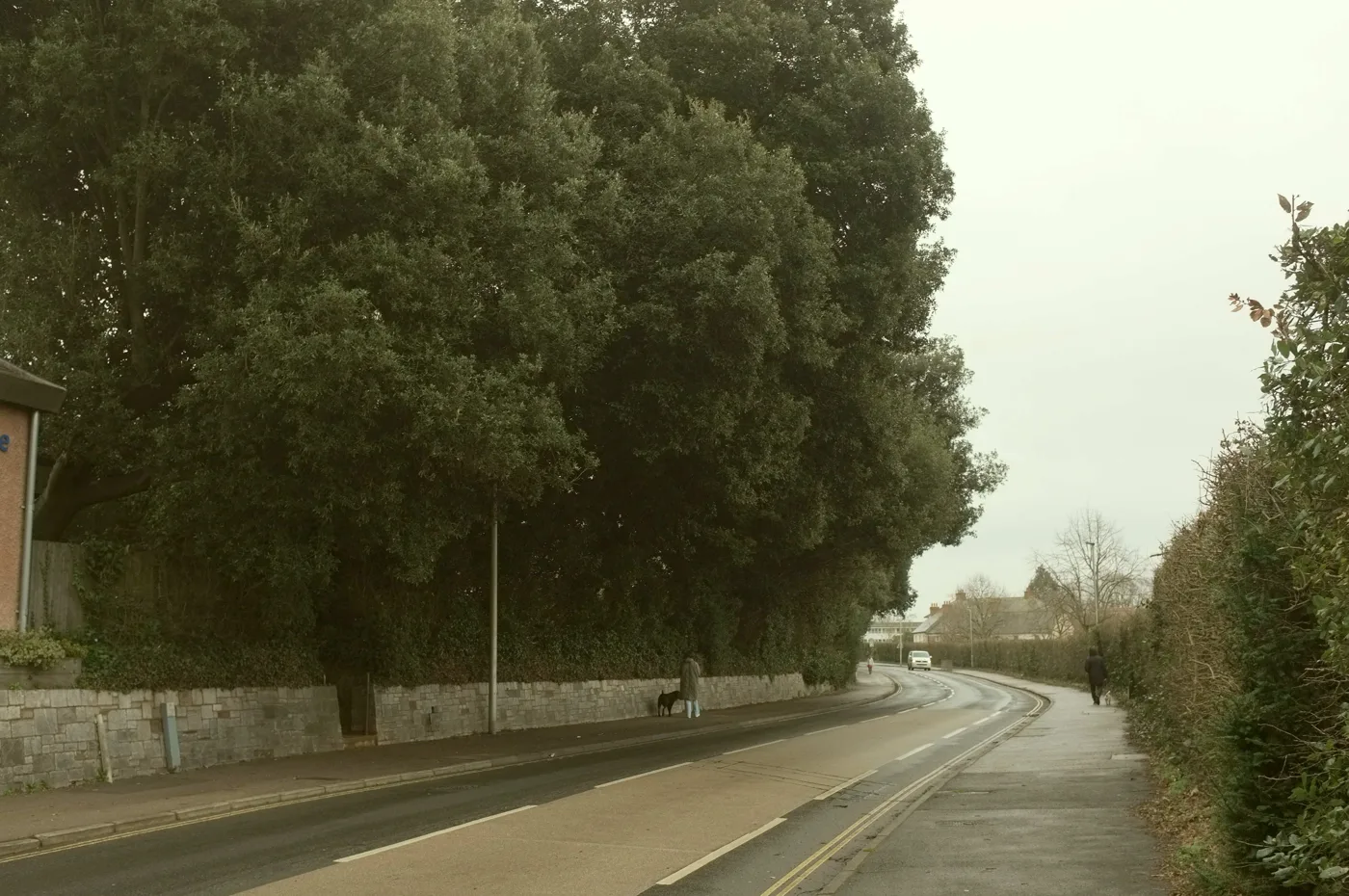

Councillors have backed a £493,281 design to reopen Exeter's Dryden Road to cars after six years. Formal objections come next; works could start in April 2027.
Dryden Road in Exeter is a step closer to reopening to cars, six years after it was shut to through traffic. Councillors have endorsed a £493,281 design for the road. Works could start in April 2027.
The road runs south of the Royal Devon and Exeter Hospital, from Barrack Road to Wonford Street. It has been closed to motor vehicles since June 2020.
Exeter’s Highways and Traffic Orders Committee (HATOC) backed the design on Monday 12 October. The draft minutes, published this week, show what was argued and what is still to be decided.
What was agreed
The committee voted to:
- endorse the changes to the road at an estimated cost of £493,281
- advertise the new road humps and, if nobody objects, put them in
- let the deputy chief executive make minor changes with the chair and the local councillors
In July the same committee agreed to advertise the order that would lift the ban on motor vehicles and extend the 20mph zone. That order has not been advertised yet. The officers’ report says it had to wait for an agreed design, so that people responding know how the road would work.
What would change on the road
The design treats the road as four sections:
- Barrack Road to Well Oak Park: advisory cycle lanes on both sides and no centre line, a zebra crossing near the Mushroom play park, and a road hump between Well Oak Park and the Devon Partnership NHS Trust entrance.
- Well Oak Park to Kipling Drive: the steepest section, with a bend. An uphill cycle lane, some kerbs moved to widen the road, and a raised table at the Kipling Drive junction.
- Kipling Drive to the Bovemoors Lane mini roundabout: one road hump. All the parking bays stay.
- Bovemoors Lane to Wonford Street: the existing raised tables refurbished, the parking bays kept and the mini roundabout left as it is.
The design came out of a workshop on 11 August between officers, the two local county councillors and the committee chair. The road has had a first-stage road safety audit, which found no critical issues that could not be fixed at the next design stage.
When it could happen
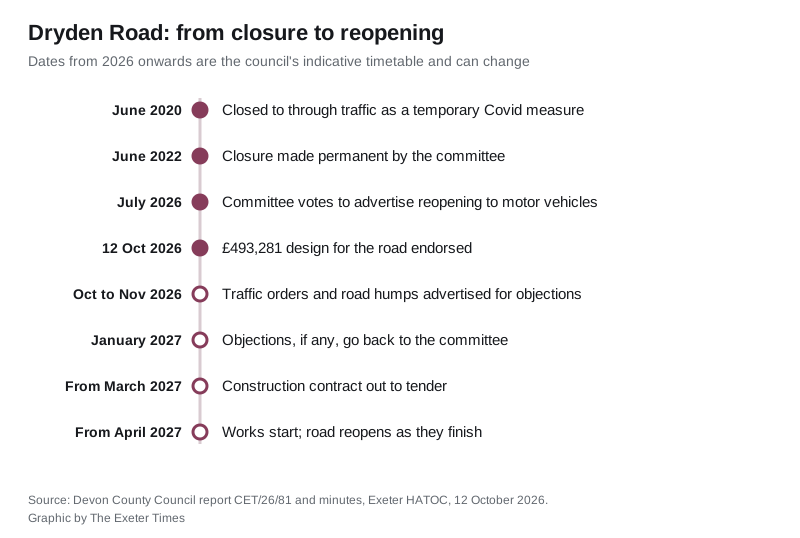
The report gives an indicative timetable:
- October to November 2026: the traffic orders and road humps are advertised, and anyone can object
- November to December 2026: the council analyses the responses
- January 2027: if there are objections, the committee decides
- From March 2027: the building contract goes out to tender
- From April 2027: works start, subject to a contractor being available. The orders take effect as the works finish.
The report says the dates and the cost “are indicative” and could change.
Where the money comes from
The £493,281 includes an allowance for design and risk. The report says the design is at an early stage and further surveys could change the cost.
- £107,000 has already been spent reconsidering the road, paid for by Active Travel England revenue funding.
- On 22 September, the Devon and Torbay Combined County Authority set aside up to £600,000 for the road across 2026/27 and 2027/28. Up to £100,000 of that is for this year’s design work.
- If the cost goes above £500,000, the scheme needs the combined authority’s approval, because that is the committee’s spending limit.
What was said at the meeting
Four people spoke under the council’s public participation scheme, including Councillor Nick Williams. The minutes say all four wanted the road reopened, and that the feeling was there should be no further delay.
Councillors raised several concerns:
- Barrack Road queues. A member said a Freedom of Information request showed modelling in which peak-time queues on Barrack Road could double. Officers said this was in the October 2025 modelling, and that the committee had been told throughout that Dryden Road and Barrack Road would be over capacity.
- A legal challenge. A member asked why councillors had not been briefed on a possible challenge from cycling groups. The council’s monitoring officer said there was no active claim to respond to.
- Bovemoors Lane crossing. Officers said it is on the county’s crossing programme, which has more than 200 schemes, and will be built when it meets the criteria.
- Active Travel England. Officers said this design had not been through the government agency’s review because of the timescale. The agency had been engaged throughout and supported an earlier, similar design.
Officers said traffic leaving Bovemoors Lane could improve air quality there, but that moving traffic can help one area and harm another.
How the road got here
The road is part of the E9 cross-city cycle route, which links Newcourt and Pynes Hill to the hospital and the city centre. The report sets out the history:
- June 2020: temporary restrictions brought in during the pandemic
- June 2022: the closure made permanent after a consultation
- July 2025: the committee asks for a review
- March to April 2026: a public consultation, which the report says showed a preference for better traffic flow while keeping walking and cycling routes
- July 2026: the committee agrees to advertise the reopening
What it means for you
- Nothing changes on the road yet. It stays closed to through traffic until the orders are made and the works are done.
- If you want a say, watch for the traffic order notice. When it appears, there is a formal period to object or support it in writing. It had not appeared on the Public Notice Portal when we checked on 21 October. We will add the closing date here when it does.
- If you drive to the hospital, reopening would give another route between Barrack Road and Wonford Street. No change before spring 2027 at the earliest.
- If you cycle the E9 route, the design adds advisory cycle lanes, but you would be sharing the road with motor traffic again.
Other closures and works in the city are on our Exeter roadworks this week page.
Have your say