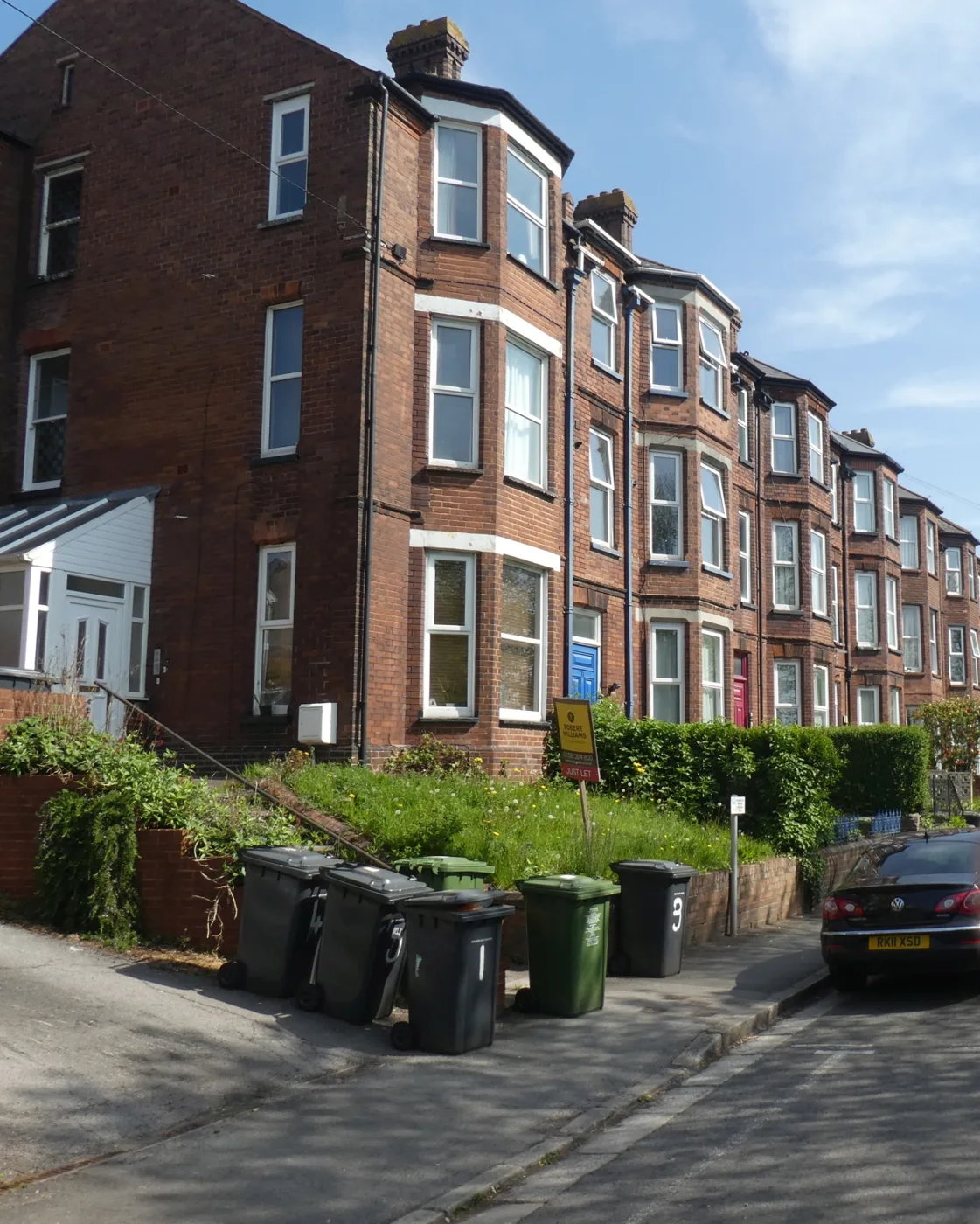

Exeter's green bin takes carrier bags but not glass, and a bank holiday pushes every round a day late. Bin days, £49 garden waste and the missed-bin deadline.
Exeter runs four containers, not three. A black wheelie bin for rubbish, a green one for recycling, a red kitchen caddy for food and, if you pay for it, a brown one for garden waste. Two things about that system catch people out more than anything else.
Glass does not go in the green bin. Carrier bags and cling film do.
That is the reverse of most councils, and it is worth reading the lists below before you next fill the recycling. This page pulls together the parts Exeter City Council splits across a dozen separate pages: what goes where, what the bank holiday does to your day, what garden waste and a bulky collection cost this year, and how long you have to report a bin the crew did not take.
Checked against the council’s own pages on 24 August 2026, with the bank holiday section updated on 30 August.
How to find your collection day
Exeter does not publish a citywide calendar, because rounds vary street by street. The council’s lookup takes any part of your address or your postcode and returns your next rubbish, recycling, food and garden waste dates, plus a downloadable annual calendar for that address.
- Use the council’s when is my bin collected lookup.
- The same tool tells you your designated collection point, which is not always your own kerb.
- You can also download your collection calendar for the year as a PDF.
- A free bin reminder service emails you the night before, and also emails you the night before a bank holiday to tell you not to put the bin out.
Rubbish is collected once a fortnight for most of the city. Some households in the city centre and in large shopping areas get a weekly rubbish collection instead. Food waste is collected every week, by a different crew from the one that takes your rubbish and recycling, so the lorries may turn up hours apart.
The times that actually matter
Exeter has a window, not a deadline. Containers must be out no earlier than 6pm the evening before and no later than 6am on collection day.
The council is blunt about what happens if you miss it: “We will not return to collect bins that are not put out in the way specified above.” The same page adds that bins must be kept on your property between collections, and that an overfilled black bin whose lid will not close is left where it stands, along with anything stacked beside it.
There is one live exception this month. The council’s bins homepage currently warns that roadworks are restricting access for some collections, and asks affected households to “leave your bins beyond the roadworks the evening before collection so crews can reach them safely”. Our Exeter roadworks page lists which streets are shut.
What goes in each bin
Green bin: recycling
Exeter wants recycling loose, not bagged. The council asks you to shake out carrier bags rather than tie material up inside them, because loose material is faster and safer for crews to sort.
Yes, according to the council’s green bin page:
- drink cans, food tins and empty aerosols
- aluminium foil
- plastic drinks bottles and cleaning bottles, empty, lids on, but no pumps
- plastic food containers, empty
- carrier bags, bread bags, polythene bags and film, and bubble wrap
- paper, newspapers, magazines, catalogues and phone directories
- cardboard, junk mail and envelopes, windows left in
- cartons
No:
- glass of any kind
- batteries
- nappies and pads
- wrapping paper and greetings cards
- pouches, for pet food or baby food
- crisp packets and confectionery packets
- blister packs and other mixed-material items
- clear film that springs open after being scrunched
- compostable items
One warning about that list. The council’s own page puts “small amounts of shredded paper inside paper envelopes or paper bags” under yes and plain “shredded paper” under no. If you have shredded paper loose, keep it out.
Black bin: rubbish
The black bin page defines the black bin narrowly, as waste from daily living that cannot be recycled. It names nappies, incontinence pads and double-wrapped broken glassware. It rules out small electricals, batteries, DIY and building waste, and garden waste, on the grounds that none of those count as daily living.
Red caddy: food waste, every week
Food waste goes out weekly in the red caddy, at your usual collection point, in the same 6pm to 6am window. Communal caddies are collected from the communal point. See the council’s food waste page.
Brown bin: garden waste, and you pay for it
The brown bin is an annual subscription, collected fortnightly and only during the growing season. Prices and this year’s start and end dates are further down the page.
Where the glass goes
Because glass is banned from the green bin, Exeter residents have two options. Neither is a kerbside collection.
- Recycling banks. The council maps every bank in the city, filterable by glass, textiles, shoes and cartons, on its recycling banks page.
- The two recycling centres, Exton Road and Pinbrook Road, both take glass bottles and jars, and both take flat glass as well.
Bank holidays: everything runs a day late
This is the recurring question, and Exeter’s answer is clear and unusually specific. The council states that “collections following bank holidays take place one day late throughout the week, with the crews working on Saturdays to catch up with Friday collections”.
So nothing is skipped and nothing is doubled up. Every round simply slides forward one day, and Saturday absorbs the Friday round.
The next one is the summer bank holiday, Monday 31 August 2026. Applying the council’s rule to that week gives:
| Normally collected | Collected instead on |
|---|---|
| Monday 31 August | Tuesday 1 September |
| Tuesday 1 September | Wednesday 2 September |
| Wednesday 2 September | Thursday 3 September |
| Thursday 3 September | Friday 4 September |
| Friday 4 September | Saturday 5 September |
The council has since confirmed exactly that table. Its news release of 27 August states that “bin collections will be a day later from Monday 31 August because of the long weekend”, sets out the same five swaps, and says collections “will resume on their normal days from Monday 7 September”. (Exeter City Council, 27 August 2026)
Check your own address on the collection day lookup before you put anything out, and sign up for the reminder emails if you would rather not think about it. The same one-day-late rule is what the council applies over Christmas and the New Year, but the shifted dates differ by round, so the per-address calendar is the only reliable source for those.
Garden waste: £49 or £61 a year
The brown bin is an annual per-bin subscription, and the 2026 charges on the council’s bin charges page are:
| Container | Annual charge |
|---|---|
| 140 litre brown bin | £49.00 |
| 240 litre brown bin | £61.00 |
| Additional 140 litre at the same address | £34.00 each |
| Additional 240 litre at the same address | £49.00 each |
| Biodegradable garden sacks | £3.50 each, minimum 5 |
The subscription is non-refundable if you cancel part way through the 12 months.
Collections are fortnightly and seasonal, not year round. The council says collections in 2026 run between 26 January and 27 November, so there is no brown bin collection in December or most of January.
Bulky waste: £15, plus £15 an item
Exeter charges a £15.00 collection charge and then £15.00 per item on top. The council’s own worked example: two items collected from outside the front of your home costs £45.00. Collections run Monday to Friday, but not on bank holidays.
DIY items carry a further charge on top of that, per the council’s bulky waste charges page:
| DIY item | Extra charge |
|---|---|
| Soil and rubble, maximum 3 sacks per booking | £4.10 per bag or item |
| Tyres, car and motorcycle only, bicycle tyres free | £7.60 each |
| Plastic window, single pane | £6.60 each |
| Plastic door or door frame, single | £6.60 each |
| Bath or shower tray | £6.60 each |
| Cistern, toilet, pedestal, hand basin or shower screen | £6.60 each |
| Insulation, one sheet or bag | £6.60 each |
| Roofing felt, one bag or roll | £6.60 each |
| Plastic pipes, guttering or fascia, up to 5 lengths to 2m | £6.60 each |
Multiple-pane windows and double doors are charged double.
Missed collection: you have until midnight the next working day
Exeter’s reporting window is short and the council enforces it. Report a non-collection “by the end of the next working day (up to midnight) following the scheduled collection day; we will not be able to return for any genuinely missed bins reported after this.”
Two other things worth knowing before you report one:
- The missed bin form reads live from the crews’ in-cab system, so it will often tell you straight away why your bin was left.
- If it says the crew has not reached your street yet, resubmit after 5pm on the collection day rather than phoning.
Too much recycling? The bigger bin is free
This is the single cheapest thing on this page. Recycling bins cost nothing, in either size, and the council will supply an extra one free if you regularly fill yours:
- 140 litre and 240 litre recycling bins: no charge
- 40 litre recycling boxes, free, for properties judged unsuitable for wheeled bins
- Extra recycling in the meantime goes out beside the green bin in clear sacks, or in sacks labelled “recycling” with the first line of your address
Rubbish bins are the opposite. A replacement black bin costs £41.50 for 140 litres, £48.50 for 180 litres or £54.50 for 240 litres, and seagull sacks are £13.00 each. Damaged bins are repaired or replaced free; lost or stolen ones are charged for.
There is no equivalent flexibility on rubbish. The council caps black bin size deliberately, will not take side waste, and will not empty a second bin without an approved application for extra capacity showing on the in-cab system.
Assisted collections
If nobody in the household can move the bins to the collection point, you can apply for an assisted collection. It covers rubbish, recycling and garden waste. It is not available where you use a communal bin store, where you have to take waste to a communal point, or where the crews would have to walk more than 20 metres. Approval lasts two years and then needs renewing.
The two recycling centres
Both Exeter sites are run by Devon County Council, not the city council. Both have a reuse shop, and both take pedestrians, though not if you have parked on the public highway and walked in.
| Exton Road | Pinbrook Road | |
|---|---|---|
| Postcode | EX2 8LX | EX4 8HU |
| Van permit system | Yes | Yes |
| Sofas and armchairs | Not accepted | Accepted, not recycled |
Opening hours are the same at both:
- Summer, April to September: Monday to Friday 9am to 5pm, Saturday and Sunday 10am to 6pm
- Winter, October to March: Monday to Friday 9am to 4.30pm, Saturday and Sunday 10am to 4.30pm
- Open all year except Easter Sunday, Christmas Eve, Christmas Day, Boxing Day, New Year’s Eve and New Year’s Day
- Quietest between 9am and 10am, and after 4pm
The upholstered seating rule is the one that will waste your afternoon. If you are taking a sofa or an armchair, it has to be Pinbrook Road; the Exton Road page says the site will not accept it.
If you are borrowing a van for the trip, check the van permit system first. Both Exeter sites run it. Privately registered panel vans and flat-bed vans need a permit, which is free, arrives as a QR code and covers 12 visits a year. Cars, pick-ups, motorcycles, fully fitted camper vans and van-based people carriers do not need one, and neither does a van hired from a legitimate hire company for less than three days, as long as you can show the paperwork on site. Vans registered to a business are refused a permit outright.
DIY waste is limited and then charged
Devon gives each household a free allowance of four single visits in any four-week period, and each of those visits is capped at either two rubble bags you can safely carry, or one unbagged item up to two metres long. Past that, the chargeable waste rates apply: £4.10 a bag for soil and rubble, £7.60 a sheet or bag for clean plasterboard, £7.60 a tyre, and £6.60 for most other DIY plastics and fittings.
One local perk is easy to miss. UPVC window and door frames, with all glass, glazing and insulation removed first, are free at both Exeter sites. Devon charges for them elsewhere.
Students and rented houses
Exeter’s waste problems spike at the start and end of the university year, and the council has a standing policy aimed squarely at it: nothing placed beside the black bin or piled on top of it, so that the lid cannot close, will be collected. Separate student and landlord guidance covers what to do with rubbish inherited from the previous tenants.
More Exeter local information
- Parking in Exeter, including the four tariff zones and where blue badges are not free
- Exeter council tax bands for 2026/27
- Exeter roadworks and travel, which currently affects some collections
- Exeter planning news
Have your say