

Band D council tax in Exeter is £2,495.36 in 2026/27, up £115.46. The full A to H table, who takes what, and the discounts and premiums that change the bill.
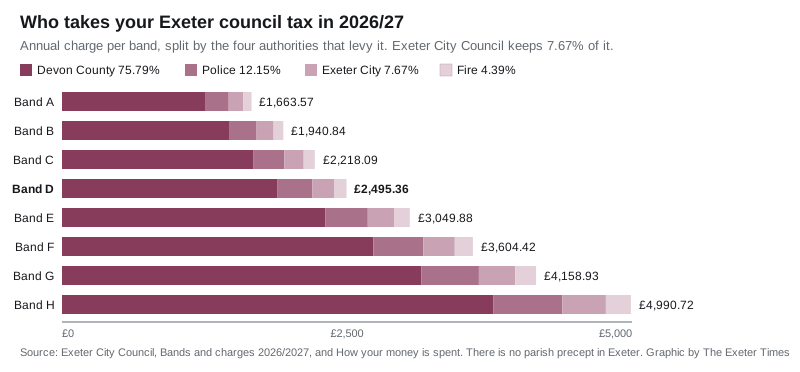
Only £191.31 of an Exeter band D council tax bill goes to Exeter City Council. That is 7.67 per cent of it. Devon County Council takes £1,891.17, which is 75.79 per cent, and the bill you pay the city is mostly the city collecting other people’s money.
Below is the full band A to H table for 2026/27, split by the four authorities that levy it, with last year’s figures alongside so you can see what actually moved. Then the parts that change what you personally owe: how to check and challenge your band, the discounts, and the premiums that can double or quadruple a bill.
All figures are Exeter City Council’s own, from its bands and charges 2026/2027 page, last updated 1 July 2026 and checked on 24 August 2026.
The full band table for 2026/27
| Band | Devon County | Exeter City | Police | Fire | Total 2026/27 | Total 2025/26 |
|---|---|---|---|---|---|---|
| A | 1,260.78 | 127.54 | 202.13 | 73.12 | 1,663.57 | 1,586.60 |
| B | 1,470.91 | 148.80 | 235.82 | 85.31 | 1,940.84 | 1,851.04 |
| C | 1,681.04 | 170.05 | 269.51 | 97.49 | 2,218.09 | 2,115.47 |
| D | 1,891.17 | 191.31 | 303.20 | 109.68 | 2,495.36 | 2,379.90 |
| E | 2,311.43 | 233.82 | 370.58 | 134.05 | 3,049.88 | 2,908.76 |
| F | 2,731.69 | 276.34 | 437.96 | 158.43 | 3,604.42 | 3,437.63 |
| G | 3,151.95 | 318.85 | 505.33 | 182.80 | 4,158.93 | 3,966.50 |
| H | 3,782.34 | 382.62 | 606.40 | 219.36 | 4,990.72 | 4,759.80 |
Police means the Police and Crime Commissioner for Devon and Cornwall. Fire means Devon and Somerset Fire and Rescue Service. There is no parish or town precept anywhere in Exeter, so this is the whole bill.
A number on the council’s own page that does not add up
The council’s band table prints £4,990.66 in the band H row, in the cell where every other band has the word “Total”. The correct 2026/27 figure is £4,990.72. That is what the four component charges add up to, and it is what the council’s own how your money is spent page gives for band H. The 66p version appears to be a typing slip in a label cell.
What went up, and by how much
The bill rose 4.85 per cent overall, but not one of the four authorities raised its share by 4.85 per cent. Exeter City Council put its own precept up by the least, in cash and in percentage terms.
| Authority | Band D 2025/26 | Band D 2026/27 | Increase | Increase |
|---|---|---|---|---|
| Exeter City Council | £185.76 | £191.31 | £5.55 | 2.99% |
| Devon County Council | £1,801.26 | £1,891.17 | £89.91 | 4.99% |
| Police and Crime Commissioner | £288.20 | £303.20 | £15.00 | 5.20% |
| Devon and Somerset Fire and Rescue | £104.68 | £109.68 | £5.00 | 4.78% |
| Total | £2,379.90 | £2,495.36 | £115.46 | 4.85% |
Of the extra £115.46 a band D household pays this year, £89.91 is Devon County Council’s. £5.55 is Exeter’s.
The county’s figure includes the adult social care precept. The Local Government Finance Settlement for 2026/27 lets authorities with adult social care responsibilities raise up to an extra 2 per cent on top of the general increase, and Devon says the council tax attributable to it includes that precept. The county does not publish the split between the two components on that page, so this page does not give one.
Check your band, and when you can challenge it
English council tax bands are still based on what a property was worth on 1 April 1991. Not what it is worth now, and not what you paid for it.
- Look yours up free on GOV.UK’s check your council tax band service, by postcode or address.
- The same service is where you start a challenge.
You have a legal right to challenge, which the Valuation Office calls making a proposal, only in defined circumstances:
- you have been paying council tax on the property for less than six months
- the Valuation Office has changed your band in the last six months
- the property has changed, for example split into several or merged into one
- the property’s use has changed, for example part of it is now used for business
- the local area has changed physically, for example a new supermarket or main road has been built
- the property has been demolished
If none of those applies you can still ask for a band review, but you have no legal right to one and the Valuation Office does not have to act on it. Either way you need evidence, and a review can move a band up as well as down.
Discounts
A full bill assumes two or more adults over 18 live in the property. Anything that changes that assumption can reduce it.
- Single occupier: 25 per cent off. If you are the only adult in your main home. You can also claim it if the other people in the household are all disregarded.
- Disregarded people. Certain residents are not counted at all, which can produce a 25 per cent or, in some circumstances, a 50 per cent discount. The council lists who is not counted.
- Disablement reduction, where a property has features needed by a disabled resident.
- Council Tax Support, a means-tested local scheme. You have to be liable for council tax to apply, and you can claim it whether you rent or own.
Students: an Exeter-sized exemption
A property occupied only by full-time students is exempt, halls included. If you live with one non-student, the bill goes to the liable person but may still attract a discount.
Exeter City Council’s test for full-time student status is:
- a course at a university or college lasting at least one academic or calendar year, requiring attendance for at least 24 weeks a year and at least 21 hours of study a week in term time, or
- you are under 20 on a course leading to a qualification up to A level or equivalent, lasting more than three months, with more than 12 hours of study a week
Distance learning, evening classes and day release generally do not qualify. Student nurses on a course leading to first registration are disregarded, but nurses already on the register taking further courses are not. A foreign spouse, civil partner or dependant of a student is disregarded if they are not a British citizen and their permission to be in the UK bars them from working or claiming benefits.
If you think you should be exempt and a bill has arrived anyway, the council’s advice is to contact the council tax office straight away rather than wait.
Premiums: where a bill doubles
Exeter charges premiums on top of the normal bill for empty and second homes, and they escalate steeply.
| Property | Premium on top of the normal charge |
|---|---|
| Empty and unfurnished up to 1 year | None |
| Empty 1 to 5 years | +100% |
| Empty 5 to 10 years | +200% |
| Empty more than 10 years | +300% |
| Second home, furnished, nobody’s main home | +100% since 1 April 2025 |
The one-year clock starts when the property first became empty and does not restart when it is sold. If an empty property becomes someone’s main home, the premium stops that day. But the reset period is six weeks: reoccupy for less than that and the premium comes straight back, and only occupation for more than six weeks buys you twelve months clear.
There is one carve-out on second homes. If your employment contract requires you to live elsewhere, you may qualify for a 50 per cent discount instead, on production of the contract. Details and the exceptions process are on the council’s council tax premiums page.
If you cannot pay
- Council Tax Support is the first port of call, and is separate from Universal Credit. You claim it from the city council even if the rest of your benefits come from the DWP.
- The Exceptional Hardship Fund covers the gap between a council tax bill and the support awarded. The council describes it as short-term relief, not a solution to long-term debt.
- Housing Payments replaced Discretionary Housing Payments on 1 April 2026 and form part of the council’s Crisis and Resilience Fund. They can cover a rent shortfall, a deposit or rent in advance, and you need to be getting Housing Benefit or the housing element of Universal Credit to apply.
Do not simply stop paying. The council can, and does, apply for an attachment of earnings order. Its difficulties making payments page is the route to a payment arrangement.
More Exeter local information
- Exeter bin collection days, including garden waste and bulky charges
- Parking in Exeter
- Exeter house prices
- Exeter roadworks and travel
- Exeter planning news
Have your say