
Exeter recycled 32.6% of household waste in 2025/26, up from 29%, as food waste reached every home. Every other Devon council fell, but Exeter is still last.
Exeter recycled 32.6% of its household waste in 2025/26, up from 29.0% the year before. It was the only council in Devon or Torbay whose rate went up. It is still the lowest of them all.
The figures are in Devon County Council’s Waste Performance Statistics 2025/26, a report to the Devon Authorities Strategic Waste Committee on 21 October. The committee noted them at that meeting.
The report says the rise takes Exeter back above 30% for the first time since 2017/18. The city’s best year was 2010/11, at 36.9%.
Where Exeter sits in Devon
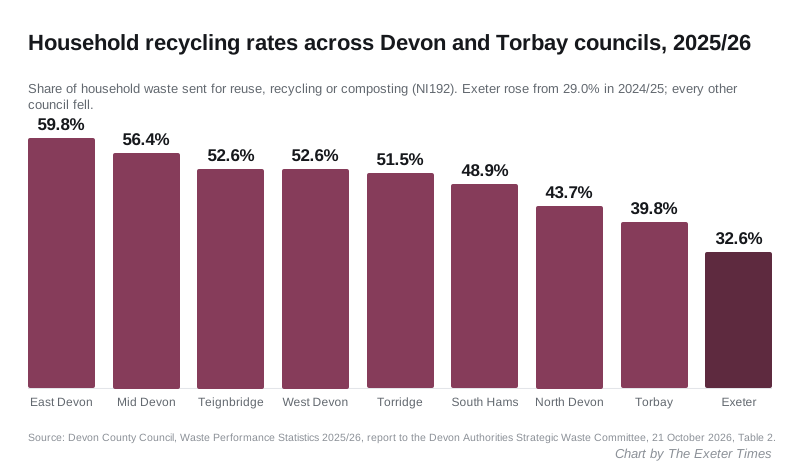
The rate is the share of household waste sent for reuse, recycling or composting. For each district it covers what the council collects from homes and bring banks. Waste taken to the county’s recycling centres is counted separately.
| Council | 2024/25 | 2025/26 |
|---|---|---|
| East Devon | 60.1% | 59.8% |
| Mid Devon | 57.9% | 56.4% |
| Teignbridge | 53.6% | 52.6% |
| West Devon | 53.8% | 52.6% |
| Torridge | 52.6% | 51.5% |
| South Hams | 49.3% | 48.9% |
| North Devon | 44.9% | 43.7% |
| Torbay | 40.7% | 39.8% |
| Exeter | 29.0% | 32.6% |
Source: Waste Performance Statistics 2025/26, Table 2.
Devon as a whole fell from 54.2% to 53.4%. The report notes that other high-performing areas in England also slipped this year.
Food waste made the difference
The rise comes mainly from food waste. Exeter’s appendix in the report shows:
- food waste collected: 2,598 tonnes, up from 1,527 tonnes, a rise of about 70%
- garden waste: 2,998 tonnes, down from 3,309
- dry recycling collected from the kerb: 3,555 tonnes, up from 3,316
- rubbish from household bins: 19,250 tonnes, down from 21,043
In a statement on 6 November, Exeter City Council put the improvement down to food waste collections reaching the whole city. Cllr Ruth Williams, the deputy leader, said she expected the rate to keep rising “as more and more households get used to recycling their food waste”.
Why Exeter’s rate stays low
Exeter has long sat at the bottom of the Devon table, and the reasons are partly built in.
Garden waste is a big one. Cllr Williams said Exeter has many homes with small gardens or none. In rural districts, she said, garden waste can add up to 18 per cent to the recycling rate. The county report says organic waste makes up about half of Devon’s recycling overall.
The way bins are collected matters too. The report credits East Devon’s high rate to three-weekly rubbish collections alongside weekly recycling.
A third factor is what gets thrown out at the sorting plant. In 2025/26, 3,282 tonnes of Exeter’s household waste was rejected at the materials reclamation facility and counted as not recycled. That was down from 3,503 tonnes. The report does not break down what was rejected or why.
The council says it is investing £12 million in a new materials reclamation facility that can handle more types of recycling. It has not given a date in its statement.
Exeter makes the least rubbish in Devon
On a different measure, Exeter leads the county. Each person in the city produced 257kg of household waste in 2025/26, down from 261kg. That is the lowest of any council in Devon or Torbay. East Devon was next at 302kg.
Rubbish left over after recycling also fell. Each Exeter household put out 391kg, down 27kg on the year before.
The report says Exeter was ranked eighth among English collection councils in 2024/25 for producing the least household waste per person. The lowest was the London Borough of Ealing, at 201kg.
What it means for you
- Use the food caddy. Food waste is the single biggest reason the rate went up, and the council expects more to come as people get used to it. Your collection day is on our Exeter bin collection days page.
- Keep the green bin clean. More than 3,000 tonnes a year is rejected at the sorting plant. Check the council’s list of what goes in before you put something in the green bin.
- Glass goes to the bank. Most of Exeter’s glass, 1,879 tonnes last year, came through bottle banks rather than kerbside collection.
About these figures
The figures are provisional local data from the Devon authorities. The government publishes the official 2025/26 statistics for every council in England later in the year. Exeter’s recycling rate counts only what the city council collects. In 2025/26 that was 35,557 tonnes of household waste, of which 11,575 tonnes were recycled or composted.
Have your say