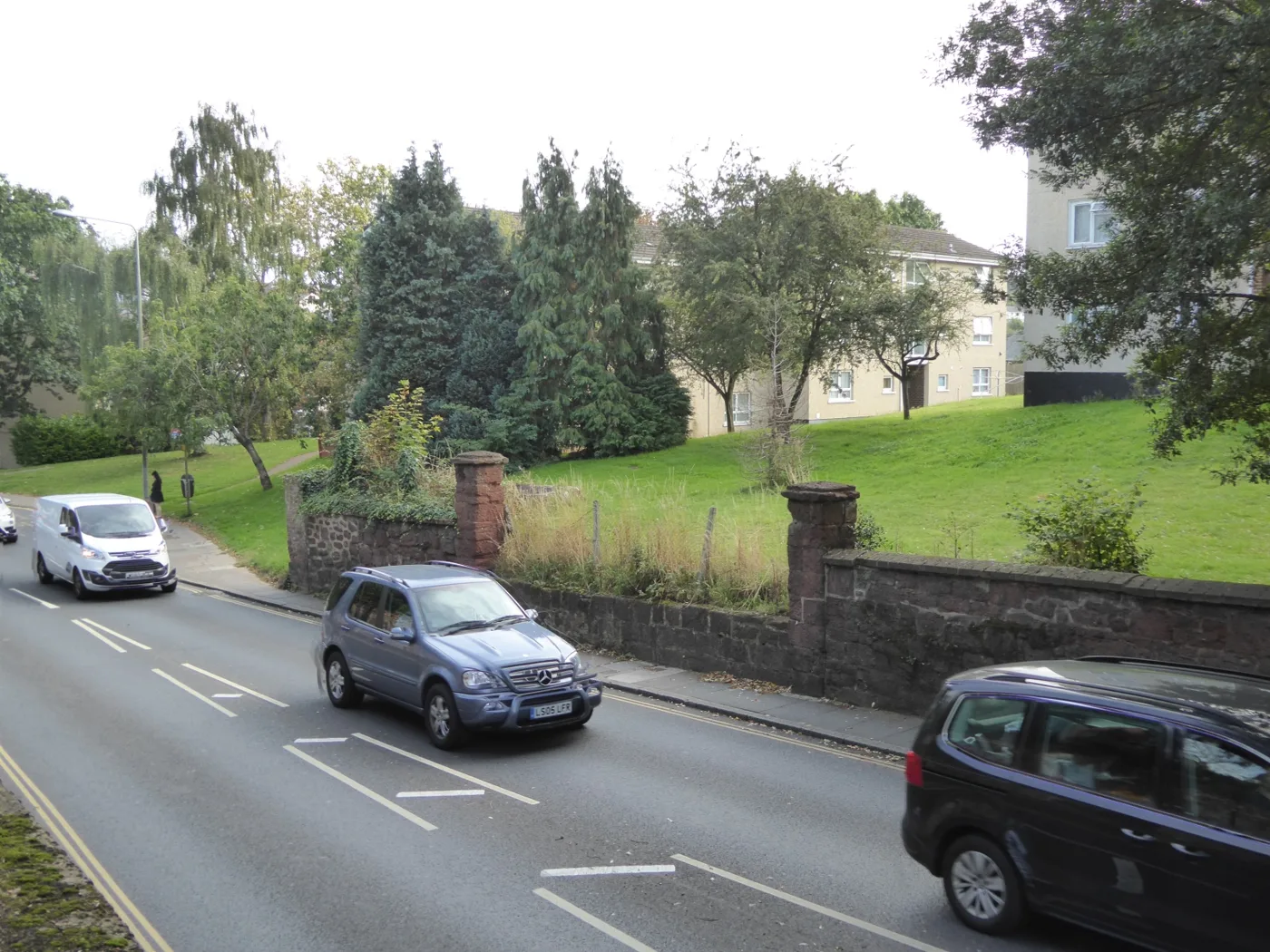

Every nitrogen dioxide monitoring point in Exeter met the legal limit in 2025, the council's air report shows. East Wonford Hill was highest, at 34.2.
Every place Exeter City Council monitors for nitrogen dioxide was under the legal limit in 2025. It is the second year in a row that no site has broken it.
The worst reading was again on East Wonford Hill, on the Heavitree corridor. It fell from 38.1 micrograms per cubic metre in 2024 to 34.2 in 2025. The legal limit for the yearly average is 40.
The figures are in the council’s Air Quality Annual Status Report 2026, which covers 2025. Councillors on the Strategic Scrutiny Committee will consider it on Thursday 19 November, along with a new four-year action plan and a city-wide air quality strategy.
Overview
- All of the council’s nitrogen dioxide monitoring points met the legal annual limit of 40 micrograms per cubic metre in 2025.
- East Wonford Hill was the highest, at 34.2. It was over the limit as recently as 2023.
- Most sites on main roads are still above the World Health Organization’s much stricter guideline of 10.
- Fine particle pollution rose at the city’s one particle monitor, on Alphington Street. The council thinks roadworks there played a part.
- The council is keeping its Air Quality Management Area for now and says it is exploring a review of Exeter’s Smoke Control Areas.
The streets with the highest readings
The council measures nitrogen dioxide with 84 diffusion tubes, mostly on busy roads and junctions, plus a roadside analyser outside the Royal Albert Memorial Museum. The scrutiny report says the results show the worst places in the city, not the average.
These are the sites the council’s action plan names as the historic problem spots, with their yearly averages from the annual report:
| Site | 2024 | 2025 |
|---|---|---|
| East Wonford Hill | 38.1 | 34.2 |
| Alphington Street | 31.5 | 31.0 |
| Pinhoe Road | 28.6 | 30.6 |
| Salutary Mount, Heavitree | 31.4 | 29.6 |
| Honiton Road | 32.2 | 29.4 |
Annual mean nitrogen dioxide, micrograms per cubic metre. The legal limit is 40.
Pinhoe Road is the one of these that went up, from 28.6 to 30.6. It is still well under the limit.
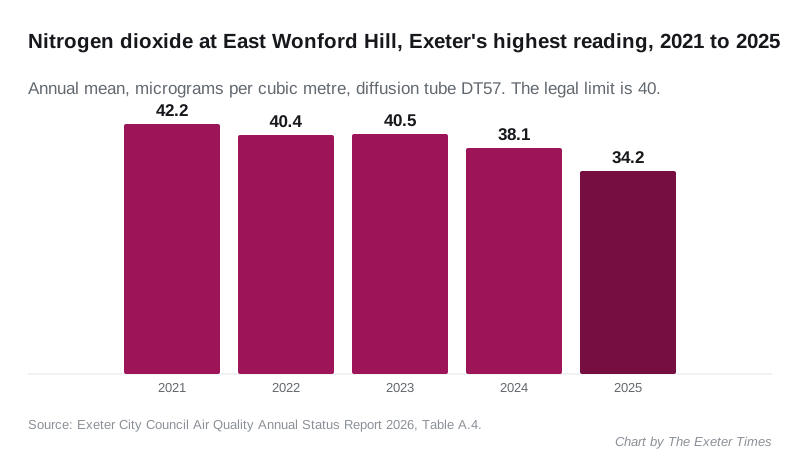
East Wonford Hill read 42.2 in 2021, 40.4 in 2022 and 40.5 in 2023, according to the annual report’s monitoring table. The scrutiny report says it was the only site over the limit in any of the last three years.
Along the busiest routes into Exeter, readings in 2025 were generally between 25 and 30. Quieter through-routes were around 15 to 20, and background sites away from traffic were under 15.
Still above the health guideline
The legal limit is not the same as the health advice. The council’s Air Quality Strategy notes that most sites along major roads are still above the World Health Organization’s guideline of 10 micrograms per cubic metre.
The strategy says local road traffic causes up to 83% of nitrogen oxides at roadside sites. Away from the roads it is about 52%.
Particles went up at Alphington Street
Exeter has one monitor for fine particles, on Alphington Street. In 2025 it recorded:
- PM2.5 at 10.1 micrograms per cubic metre, up from between 8.5 and 9.0 in 2022 to 2024
- PM10 at 17.0, up from between 14.1 and 15.1
Both are below the national objectives. The strategy puts the rise down to roadworks nearby from late March 2025. It says particle levels at the site are “relatively constant, but not improving, unlike nitrogen dioxide levels”.
With only one monitor, the council says it does not know enough about particles across the city. It plans to look at adding more.
Wood burners and the Smoke Control Areas
For fine particles, the strategy names burning solid fuel at home as the biggest source the council can do anything about.
The council says it will uphold Exeter’s existing Smoke Control Areas. It is also “exploring review and revision” of them, subject to agreement and funding. Any change would have to go through the legal process first.
People who answered the council’s summer consultation raised wood burning, particularly for children and people with health conditions. They also raised bus fares and reliability, safe walking and cycling routes, and traffic idling on the main roads. The consultation ran from 3 July to 14 August and drew 311 responses.
What the new plans do
The action plan for 2026 to 2030 has 26 measures in five areas:
- sustainable public transport
- safe and healthy walking and cycling
- reducing the effects of road traffic
- protecting public health and vulnerable communities
- awareness and air quality information
The council is keeping its Air Quality Management Area, which covers the main routes into the city. The annual report says it had considered shrinking it to East Wonford Hill alone. Its long-term aim is to remove the area altogether, once the readings show the improvement has lasted.
The government’s appraisal of the report, issued in August, described this as “a preventative and strategic commitment” to improving air quality.
What happens next
- Thursday 19 November, 5.30pm: Strategic Scrutiny Committee, Rennes Room, Civic Centre
- 15 December: Executive
- 12 January 2027: full Council, which would adopt the action plan and the strategy
The scrutiny report says most of the cost of measures outside the council’s control, such as transport schemes, would fall to Devon County Council. Any new spending would need its own approval.
What it means for you
- If you live on the Heavitree corridor, the air outside your home is cleaner than it was, and within the legal limit. It is still the most polluted stretch in the city.
- If you burn wood or coal at home, check whether your street is in one of Exeter’s Smoke Control Areas. The council says it is exploring changes to them.
- If you want to see the readings, the council publishes live air quality data and every past annual report on its monitoring page.
- If you want to watch, the committee meets in the Rennes Room at the Civic Centre, Paris Street. The agenda says the press and public are unlikely to be excluded.
Have your say