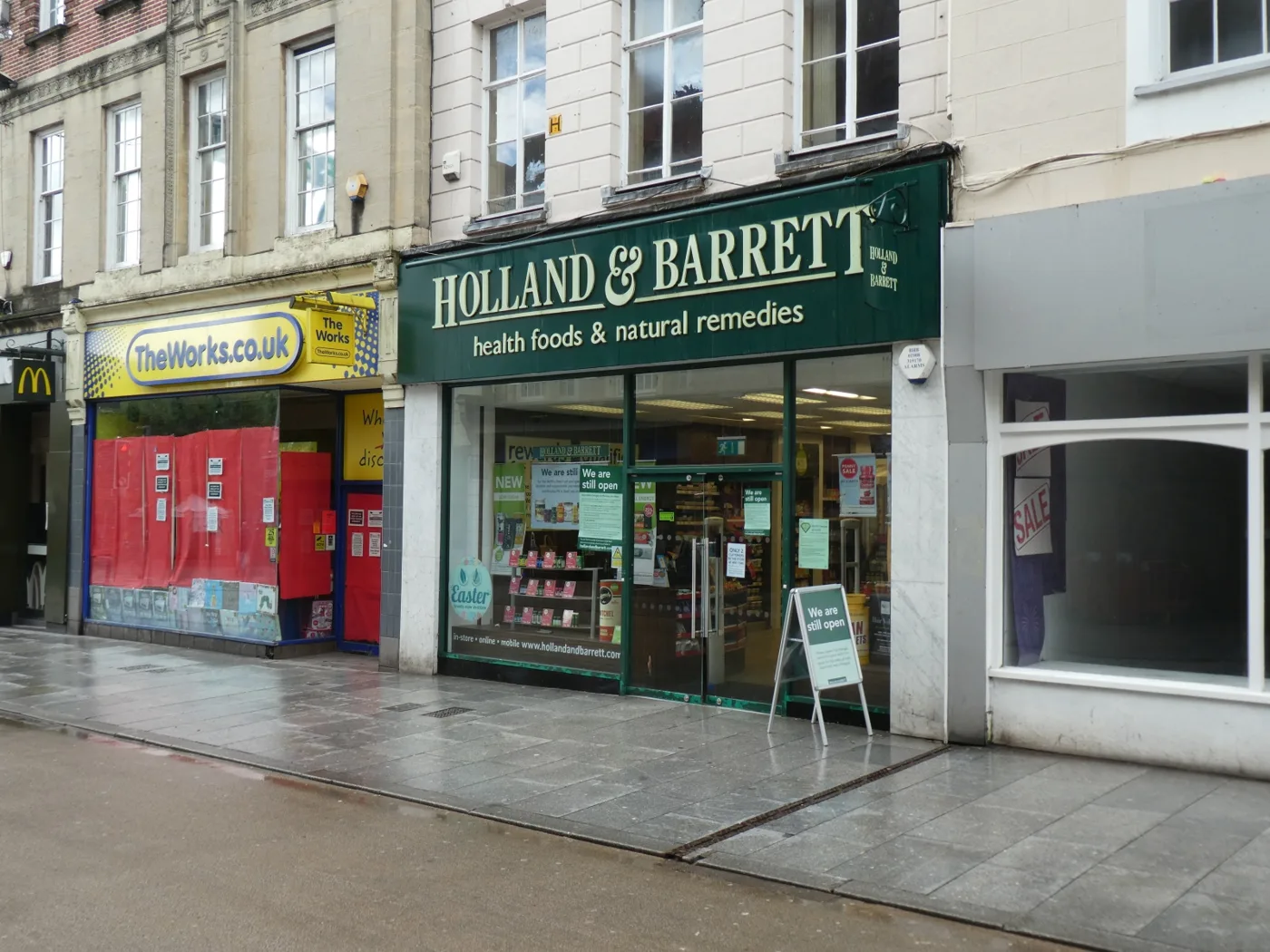

Exeter City Council refused eight flats above 192 High Street because three fell below national space standards and seven had no outdoor space.
Eight flats planned above the former Holland & Barrett at 192 High Street were refused because they would have given residents poor living conditions. Three of the flats were smaller than the national minimum, and seven of the eight had no outdoor space.
Exeter City Council issued the refusal on Monday 9 November. Its decision notice and the officers’ report dated 27 October are now on the planning file for 25/1238/FUL.
The Grade II listed building is currently empty. The council says it “strongly supports bringing this vacant listed building back into use”. Its objection is to this scheme, not to flats in the building.
Why it was refused
The decision notice lists the problems with individual flats and the building as a whole:
- Flat 1: poor outlook and light to the bedroom
- Flat 2: poor outlook and light to the kitchen and lounge
- Flat 3: smaller than the national space standard
- Flat 4: poor layout, poor outlook from the kitchen, and smaller than the standard
- Flat 7: smaller than the standard
- Outdoor space: seven of the eight flats would have none
- Noise: residents could not open their windows “without being exposed to excessive noise”
- Ventilation and heat pumps: not enough information to show they would not add noise
- Bike store: poorly designed, and not usable as drawn
The scheme had no parking, so the council said the failed bike store left a car-free building with no workable cycle storage at all.
How small the flats were
The officers’ report gives the floor areas against the government’s nationally described space standard:
| Flat | Size | Floor area | Minimum |
|---|---|---|---|
| Flat 3 | Two bedrooms, up to 4 people | 67 sq m | 70 sq m |
| Flat 4 | One bedroom, 2 people | 37 sq m | 50 sq m |
| Flat 7 | One bedroom, 2 people | 44 sq m | 50 sq m |
Flat 4 was 13 square metres short, about a quarter below the minimum. Flat 7 would have been built in one of the new roof extensions.
The noise problem
The building sits between the High Street and the rooftop plant of 190 to 191 High Street. The applicant’s acoustic assessment put the side facing that plant in the “high risk” category for noise at night, before any mitigation.
The case officer visited in June 2026 and heard outside noise from inside the building. The report says the plant noise was “particularly noticeable” in some upper-floor rooms.
The council’s environmental health team did not object. The acoustic assessment proposed secondary glazing on the High Street front, extra wall linings, better glass and mechanical ventilation. But the report notes that ventilation was needed because “the living environment would be too noisy with windows open”.
The bike store
The ground floor plan showed wall-hung racks for eight bikes in the entrance area. That number met the council’s rules.
The report says the space was only 0.4 metres deep. The council’s urban design officer advised that at least 1 metre was needed, so adult bikes were unlikely to fit. Exeter Civic Society said reaching the store would mean “three 90-degree turns” and three doors.
What the council did accept
Officers were content on several points:
- The roof extensions: some harm to the listed building, including the loss of a 19th century roof over Flat 7, but similar extensions were not objected to in 2024
- The High Street front: unaffected
- Air quality: the applicant’s survey found no need for mitigation
- Bins: two 1,100 litre bins would fit in the basement store
The report also confirms the council can show a five-year housing land supply, at “5 Years and 3.5 Months” as of November 2026.
This is the second refusal for flats in the building. A plan for nine flats (24/0415/FUL) was refused in 2024 on similar grounds, as our earlier report on the scheme set out.
What it means for you
- Nothing changes on the High Street for now. The upper floors stay empty and the shop unit below is not part of the decision.
- The applicant can appeal to the Planning Inspectorate. The decision notice explains how. They could also try a third design.
- The listed building consent application for the same works, 25/1239/LBC, was still marked Pending Consideration on 12 November.
Have your say